
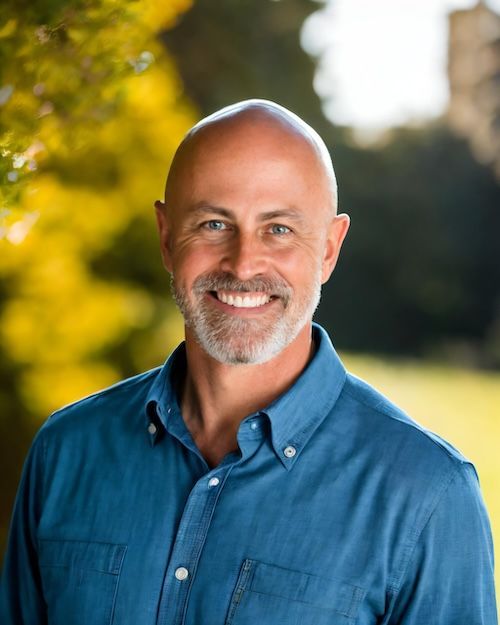
Thirty years in financial services. One fee, tied to the work rather than the balance. Virtual meetings for clients across the United States.
The short version
I have spent more than thirty years in financial services, across banking, management consulting, investment management and mortgage. I worked in New York and spent nearly eight years in Tokyo with global financial firms before building my own advisory business.
I studied Finance and Japanese at the University of Notre Dame, which is how Tokyo happened.
For fourteen years I started, owned and ran that wealth management business. Ten clients at the beginning, 225 by the time I sold my interest at the end of 2019.
Then I left the industry entirely for a while. That turned out to matter more than anything else on this page.
Why I started buying stocks at thirteen
I had a paper route. I took the money from it and bought stocks. I was thirteen.
That is not a story about being precocious. It is a story about what I find interesting, which has not changed in forty years. I like the puzzle. I like watching how a set of decisions made over decades either compounds into freedom or quietly does not.
What I did not understand at thirteen, and would not understand for another twenty years, is that almost none of the difficulty in personal finance is mathematical.
What the years away taught me
After I sold my interest in the firm, I worked in other industries. I did not plan to come back.
Inside that same stretch of about six years I also went through a separation and divorce, sold a company, changed industries, lost a job, dealt with medical emergencies, got engaged, and started a new business. Some of that was chosen. Most of it was not.
I did the work. Therapy, self-examination, accepting my own part in how my marriage ended, and rebuilding a certain amount of physical health along the way. I ran my first half marathon at fifty-two.
Two things came out of that period.
The first is that I earned the Certified Divorce Financial Analyst® designation, because I had watched from the inside how badly grief and anger distort financial judgment, and I had made some of those mistakes myself.
The second is that being outside the industry let me see it clearly for the first time. I had spent fourteen years inside a compensation model I had never examined closely, because everybody around me used it too. From the outside, the problem was obvious.
The client I lost
Before I sold the business, I lost a client I had worked with for twelve years. He had been approached by a flat-fee advisor and asked if I would match the fee. I could not. He left.
It hurt, and I sat with it for a long time.
The conclusion I came to is that my fee was not tied to the work I performed. It was tied to the size of his account. Those are two different things, and the industry has spent decades hoping nobody notices.
Everything about how I practice now comes out of that.
How I actually work
I manage portfolios myself rather than handing them to a model portfolio provider. I stay hands-on and I adjust when the situation calls for it, which is different from trading on predictions. I do not make market forecasts and I do not know what the next twelve months hold. Nobody does.
I have been through every part of an economic cycle with clients, including 2008 and 2009. That period taught me more about how people actually behave with money than any credential did.
I play a lot of roles that are not in the job description. Coach. Sounding board. Occasionally something close to a consigliere. You get me, and I get to know who you really are, where you are trying to get to, and what path is likely to get you there.
I am your partner in this. We solve it together.
Credentials
CERTIFIED FINANCIAL PLANNER™ · Tax Planning Certified Professional® · Certified Divorce Financial Analyst® · Chartered Retirement Planning Counselor™
Those establish competence. They are not the reason to hire me. Twenty years of watching people make consequential decisions with money is closer to the reason.
Verify me:SEC IAPD · CFP Board · Form ADV Part 2
Start a conversationTwelve questions to ask any advisor